Where History Flows Together
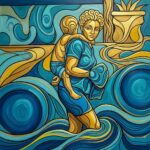
The meeting of the Niger River and Benue River is more than just a geographical event; it is the historical anchor of the Nigerian nation. For centuries, these two “highways” allowed for the flow of empires, trade, and eventually the colonial forces that shaped modern West Africa. Today, the point where these giants meet in Lokoja remains a symbol of unity and a natural marvel that continues to capture the world’s imagination.
1. The Birthplace of "Nigeria"
The most significant historical fact about the confluence is that the country’s name was born here. In 1897, British journalist Flora Shaw (later Lady Lugard) looked at a map of the “Niger Area” and proposed the name “Nigeria.” She saw the confluence as the central heart of the territory, making these rivers the literal namesake of the nation.
2. The "Y" Mark: A National Symbol
The meeting of these rivers at Lokoja (lo-KO-jah) forms a perfect “Y” shape. This natural landmark is so central to the national identity that it is featured on Nigeria’s coat of arms. The two silver wavy bands on the shield represent the Niger and Benue flowing together to unify the country.
3. The Great "Color Line" Mystery
Historically, travelers have been fascinated by the fact that the two rivers don’t mix immediately. The Niger is typically a brownish, silty color, while the Benue is often a clearer, greenish-blue. They flow side-by-side for several kilometers before their densities and temperatures equalize, allowing them to finally blend.
4. The "Mother" and the "Great River"
The indigenous names of the rivers reveal their ancient importance.
Benue: Derived from the Batta (BAH-tah) word Binué, meaning “Mother of Water.”
Niger: Believed to come from the Tuareg (TWAH-reg) phrase gher n gheren, meaning “River of Rivers.”
5. The European "Quest" for the Source
For centuries, the course of these rivers was a mystery to the West. While Mungo Park is famously credited with reaching the upper Niger, it was the Lander Brothers (Richard and John) who finally proved in 1830 that the two rivers merged and flowed into the Atlantic. This discovery opened the interior of Africa to global trade.
6. The First Capital of the North
Because the confluence was a strategic crossroads, the British made Lokoja the first administrative capital of Northern Nigeria. It served as the military headquarters for the Royal Niger Company, which controlled the trade of palm oil and kernels along the riverbanks.
7. The Volume Giants
While the Niger is the third-longest river in Africa, the Benue is actually wider at the point of confluence. When they meet, the Benue nearly doubles the volume of the Niger’s discharge, creating a lake-like stretch of water nearly two miles wide that is dotted with seasonal sandbanks.
8. Ancient "River Highways" of Trade
Long before paved roads, the confluence was the center of a massive trade network. The Nupe (NOO-peh), Igala (ee-GAH-lah), and Ebira (eb-EE-rah) people used these waters to exchange salt from the north for ivory and forest products from the south, making the confluence a historical “melting pot” of cultures.
9. Mount Patti: The Historical Watchtower
Standing 1,349 feet (411 meters) tall, Mount Patti (PAT-tee) overlooks the confluence. It served as a lookout for early inhabitants and later as a “rest house” for Lord Lugard. It remains the best vantage point for historians and tourists to view the entire “Y” shape.
10. The Seasonal Islands
In the dry season (around February), the water levels drop to reveal large sandbanks and islands. Historically, these were neutral grounds where different ethnic groups held markets and festivals. These islands disappear entirely during the rainy season, a cycle that has dictated local life for generations.
The Living Legacy of the Confluence
The history of the River Niger and River Benue is not just found in old maps or colonial records; it is alive in the people who still navigate these currents today. Whether they are the farmers watching the seasonal rise or the modern researchers tracking the flow, the human element is what truly defines these waters. If you want to dive deeper into the people who have shaped our understanding of these waterways, check out The River Mixer’s Guide to River Figures: Defining the Explorers, Protectors, Challengers, Storytellers, and Locals. Understanding the history of the confluence is the first step in appreciating the “River Figures” who continue to tell its story.
Keep them clean!
The history of the River Niger and River Benue is a story of life and abundance, but that legacy depends entirely on the health of the water. For centuries, these rivers have provided for the people along their banks, yet today they face the modern threats of plastic pollution, industrial runoff, and waste. Keeping these waterways clean is not just an environmental chore—it is an act of respect for our heritage. When we protect the purity of the confluence, we ensure that the “Mother of Water” and the “River of Rivers” can continue to support the farmers, fishermen, and families who rely on them. A clean river is a living history that we must pass down to the next generation.
F.A.Q.
The two rivers meet at Lokoja (lo-KO-jah), a historic city in Kogi State, Nigeria. This specific geographic point is known as the confluence.
The name “Nigeria” was proposed in 1897 by British journalist Flora Shaw (later Lady Lugard). She derived the name from the “Niger Area” while looking at a map of the territory surrounding the river.
This is a natural phenomenon caused by different sediment loads. The Niger is typically a brownish, silty color, while the Benue tends to be a clearer, greenish-blue. They flow side-by-side for several kilometers before their temperatures and densities equalize and they finally mix.
Benue: Comes from the Batta word Binué, meaning “Mother of Water.”
Niger: Likely comes from the Tuareg (TWAH-reg) phrase gher n gheren, meaning “River of Rivers.”
The meeting of the rivers forms a “Y” shape, which is featured on the Nigerian Coat of Arms. It is depicted as two silver wavy bands (a “pall”) on a black shield, representing the unification of the country.
Additional resources
- Howard J. Pedraza: Borrioboola-Gha: the story of Lokoja, the first British settlement in Nigeria. xii, 118 pp., 7 plates. London, etc.: Oxford University Press, 1960. 18s. | Bulletin of SOAS | Cambridge Core
- Mastering the Niger: James MacQueen’s African Geography and the Struggle over Atlantic Slavery, Lambert
- Amazon.com: Peoples of the Niger-Benue Confluence (Ethnographic Survey of Africa): 9781138239975: Forde, Daryll, Brown, Paula, Armstrong, Robert: Books
- Travels of Richard and John Lander into the interior of Africa, for the… | Project Gutenberg
- The Niger River – Ayikwa