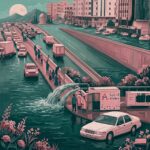
Lyrics: The Brahmaputra River "Father Brahma""
[Verse 1] Father Brahma, I am calling from the roof of the world,
Where the banners of the mountains are frozen and furled.
In the peaks of China, I am Yarlung Tsangpo,
A glacier turquoise ribbon in the high Tibetan snow.
I call out to the child of the future, “Do you hear my sound?”
I am the highest river, above the common ground.
But as I fall through canyons, leaving China’s cold embrace,
I change my name and color as I find a lower place.
[Chorus] I enter India’s valley, the Brahmaputra Son,
Two thousand nine hundred kilometers for the race I run.
My skin is dusty copper where the heavy metals slide,
And the Mising people’s houses vanish with my tide.
But the NGO Aaranyak is the heartbeat in the flow,
The steady hand that’s helping me to heal and to grow.
[Verse 2] I flow past the Peacock Island, where Shiva’s fire was cast,
The black basalt boulders are the anchors of the past.
The Bengal Florican is the ghost within my grass,
Watching the industrial silt and the shadows as they pass.
Then I reach the Bangladesh border, where the land is wide and low,
As the Jamuna river, I let my spirit go.
The recovery clock is ticking, one hundred twenty years to mend,
And the NGO Aaranyak is the force on which I depend.
[Outro] One hundred twenty years until the turquoise is returned,
A lesson in the silt that the nations finally learned.
From Yarlung Tsangpo to the Jamuna by the sea,
I wait for the day that the Son is truly free.
[The Hook] I am the highest river on Earth, changing from China’s Yarlung Tsangpo to India’s Brahmaputra and the Jamuna in Bangladesh. But in my grass, the Bengal Florican has become a ghost, its home destroyed by dams and silt. I carry a D-plus heart and a hundred-twenty-year recovery clock—will you help me bring the turquoise back?
The Story of "Father Brahma"
“Father Brahma” is a haunting documentation of a river losing its identity. We begin at the “Roof of the World” with the Yarlung Tsangpo, where the frequency is set to a pristine Glacier Turquoise. However, as the data moves across the borders of China, India, and Bangladesh, the audio spectrum becomes crowded and chaotic. The “braiding” of the river—caused by massive deforestation—is represented by overlapping, clashing synth leads that simulate the water’s aggressive, unpredictable path.
The track carries the weight of the Peacock Island Fire. Just as Shiva’s fire left behind black basalt boulders, industrial-scale agriculture and dam construction are leaving behind a scorched ecosystem. The Bengal Florican acts as a “Wildlife Ghost” in the mix—a high-pitched, fading trill that disappears as the industrial “Dusty Copper” siltation rises. This is the sound of a 2,900km race against a 120-year Recovery Clock, anchored by the steady, percussive pulse of the Aaranyak restoration efforts.
Brahmaputra River Health Report
Health Score: D+
Emergency Drinkable?: No. High risk of heavy metals and parasites.
Primary Villain: Industrial Siltation & Sewage
Visual Color: Glacier Turquoise (Natural) vs. Dusty Copper (Current).
Indigenous Loss: Displacement of Mising people’s river-island (char) villages.
Wildlife Ghost: The Bengal Florican (Houbaropsis bengalensis); critically endangered due to dam-disrupted flood cycles.
Recovery Clock: 120 Years
Restoration Effort: Aaranyak
Country: China, India, Bangladesh
Name Origin / Etymology: Endonym: Yarlung Tsangpo (Tibetan). Sanskrit: Brahmaputra; “Son of Brahma.” Language: Indo-Aryan.
Lore & Legends: The Peacock Island Fire; dark basalt boulders on Umananda Island are the ashes of Kamadeva, burnt by Shiva’s third eye.
Narrative Summary: This Himalayan giant is being choked by massive deforestation and industrial runoff. The physical volume of silt is raising the riverbed, causing the water to “braid” aggressively and wash urban toxic waste into the fertile plains.
Deep Dive: Interpreting the Data
Grade A (Pristine): The water is safe to drink with minimal filtration. The ecosystem is intact, and indigenous traditions thrive alongside the natural flow.
Grade B (Stable): Healthy but showing signs of stress. Some agricultural or urban runoff is present, but the river remains a reliable resource for the community.
Grade C (At Risk): Significant pollution is present. The water requires professional treatment to be safe, and certain wildlife species are beginning to struggle or migrate.
Grade D (Critical): High toxicity levels. The river has become dangerous for humans and animals alike, and the “Recovery Clock” is now measured in decades.
Grade F (Failing): The river is biologically “dead” or extremely toxic. It is unsafe to touch or drink, and the local indigenous way of life has been fundamentally broken by industrial “Villains.”
Here is the updated list with bullet points and the definitions following the colons:
Health Score: A simplified rating or grade used to communicate the overall biological and environmental integrity of a specific location.
Emergency Drinkable?: An assessment of whether the primary water source can be safely consumed by humans in a crisis and a list of the specific contaminants preventing it.
Primary Villain: The specific human activities, industries, or mechanical processes identified as the leading causes of environmental degradation in the area.
Visual Color: A comparison between the appearance of the environment in its healthy state versus its current appearance under stress.
Indigenous Loss: A measure of the impact on local human populations, specifically those whose traditional livelihoods and cultures are tied to the natural resource.
Wildlife Ghost: A spotlight on a specific animal or plant species that has become rare or functionally extinct, serving as a symbol for the ecosystem’s decline.
Recovery Clock: The estimated duration of time—often measured in decades or centuries—required for the system to fully heal if all damaging activities were to cease.
Restoration Effort: The names of the specific groups, alliances, or legal movements working to protect or rehabilitate the area.
Country: The geopolitical regions or nations that have jurisdiction over, or are directly impacted by, the state of the environment.
Name Origin / Etymology: An exploration of the linguistic history of the area’s name, showing how it reflects the cultural or religious history of the people who live there.
Lore & Legends: The traditional stories, spiritual beliefs, or unexplained natural phenomena that give the location its cultural and sacred significance.
Narrative Summary: A concise explanation of the “cause and effect” chain, detailing how specific stressors lead to the physical collapse or transformation of the landscape.
About BasinScore™
Every track we produce is a BasinScore™—a rhythmic data profile that transforms the complex metrics of our Global River Health Index into a visceral auditory experience via the Basin Beats™ studio. By centering our production on this singular metric, we bridge the gap between cold scientific observation and human empathy, allowing listeners to hear the current health, industrial history, and future outlook of a living river basin. These scores provide an essential “vibe check” on the water, highlighting critical river-related flood risks and conservation needs through a beat that ensures the data always hits the right note.