The River's Deposit: What Are They?
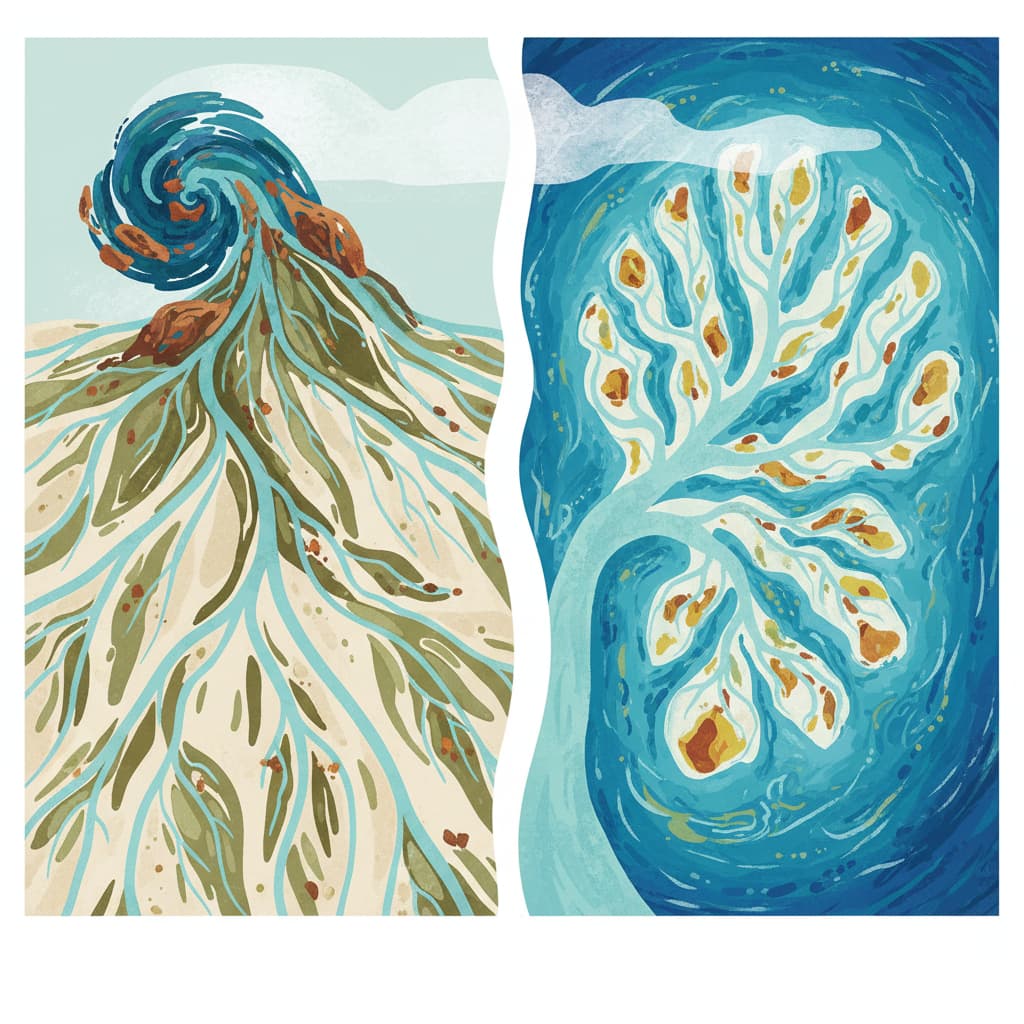
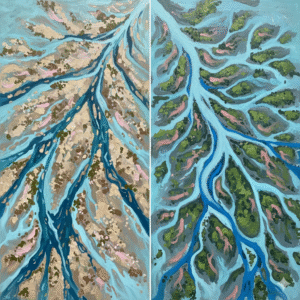
Rivers are powerful sculptors of the Earth’s surface, constantly eroding, transporting, and depositing sediment. When a river’s energy suddenly drops, it can no longer carry its load, leading to the creation of distinctive landforms. Two prime examples of these depositional features are alluvial fans and deltas. While both are built from materials carried by a river, their formation environments and resulting characteristics are surprisingly different, offering unique insights into hydrological processes. It’s easy to confuse the two because, visually, both are essentially fan-shaped accumulations of river-deposited sediment; they just appear in dramatically different geographic settings.
Born on Land vs. Born at Sea: Environmental Differences
The most significant distinction between alluvial fans and deltas lies in where they form. An alluvial fan is a terrestrial phenomenon, typically found at the base of steep mountain ranges or canyons where a confined river channel suddenly emerges onto a broad, flat plain. Here, the sudden loss of confinement and gradient causes the river to spread out and dump its coarser sediment load. In contrast, a delta forms at the mouth of a river where it empties into a larger, standing body of water like an ocean, sea, lake, or even a reservoir. The river’s velocity slows dramatically upon meeting the still water, leading to the deposition of finer sediments.
Carry the Sacred Flow of the Ganges
Shape, Slope, and Sediment: Distinctive Characteristics
Beyond their location, their physical attributes also set them apart. An alluvial fan is characterized by its shape as a section of a cone or fan with a distinct apex (point) at the mountain front. Its surface has a relatively steep slope that decreases gradually outward, a gradient that helps gravity distribute the sediment. The main channel often braids and shifts frequently across the fan surface. Conversely, a delta is often a triangular or arcuate (bow-shaped) form, resembling the Greek letter delta (Δ). It possesses a very gentle, near-horizontal slope that extends from the subaerial (above water) top down to the subaqueous (underwater) bottom. Instead of braiding, the main channel typically splits into several smaller, diverging channels called distributaries. While fans are dominated by coarse gravels, deltas are primarily composed of fine silts and clays.
Alluvial Fan Examples (Terrestrial Deposits)
These fan-shaped deposits are typically found at mountain fronts in arid or semi-arid regions:
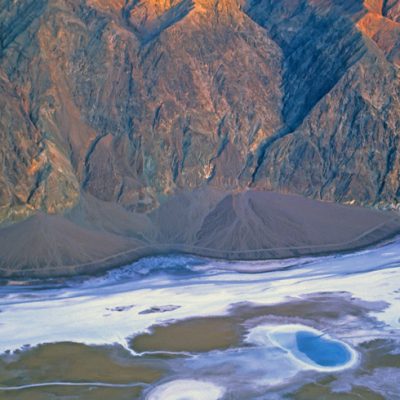
Death Valley, California, USA: This location is a classic textbook example, featuring dozens of pristine alluvial fans spilling out dramatically from the steeply rising ranges onto the valley floor.
The Kosi River Megafan, India/Nepal: This is one of the world’s largest modern alluvial fans (sometimes called a megafan), formed by the Kosi River as it exits the Himalayas onto the Indo-Gangetic Plain.
Tente River Fan, Kazakhstan: Found at the base of the Dzungarian Alatau range, this fan is utilized for agriculture due to its relatively flat surface and the groundwater it holds.
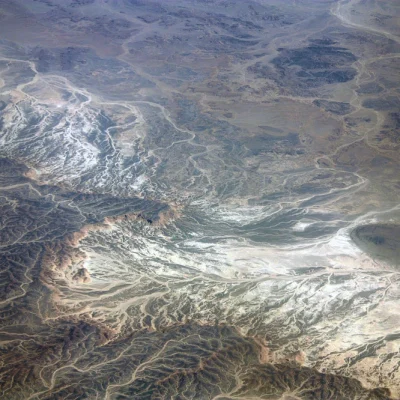
Wadis of Egypt (Gulf of Suez): Along the steep coastal escarpments, numerous small, ephemeral streams (called wadis) have created multiple coalescing alluvial fans (a feature known as a bajada).
Owens Valley, California, USA: The base of the Sierra Nevada Mountains is fringed by large, well-formed alluvial fans that empty into the valley floor, illustrating the powerful erosional force of mountain streams.
River Delta Examples (Coastal Deposits)
These landforms are massive, low-lying plains formed where major rivers empty into standing bodies of water:
The Ganges-Brahmaputra Delta, India/Bangladesh: This is the largest delta in the world, creating a vast, fertile plain known for the Sundarbans mangrove forests and an extremely dense human population.
The Mississippi River Delta, USA: Famous for its distinctive “bird-foot” shape, this delta extends into the Gulf of Mexico, supporting a critical ecosystem and major industrial infrastructure.
The Nile River Delta, Egypt: A classic example of an arcuate (bow-shaped) delta, it has been a cradle of civilization for millennia, providing the fertile land that supported ancient and modern Egyptian agriculture.
The Mekong Delta, Vietnam: Often called the “Rice Bowl” of Vietnam, this complex network of rivers, canals, and swamps is one of the most productive agricultural regions in Southeast Asia.
The Okavango Delta, Botswana: A unique exception, this is an inland delta where the Okavango River does not flow into the sea but instead fans out into the Kalahari Desert, creating a massive, seasonal wetland.
Life Along the Deposits: Human Settlements
These unique landforms attract different types of human settlement and activity, each resulting in distinct cultural adaptations. Communities around alluvial fans often live at the mercy of sudden floods, but they are masters of water harvesting, relying on the predictable collection of groundwater beneath the fan’s permeable sediments. For example, communities in the Southwest U.S. and parts of Central Asia have developed traditional agricultural and water-management techniques optimized for these arid, high-hazard landscapes. Delta regions, however, are historically some of the most fertile and densely populated areas on Earth. The rich, fine sediments deposited by rivers create incredibly productive agricultural land, supporting massive populations and bustling cities. The Ganges-Brahmaputra Delta is home to the Bengali people (in Bangladesh and India) whose culture is deeply tied to rice cultivation and the complex riverine environment. In the Mekong Delta of Vietnam, the Kinh people are renowned for their floating markets and specialized aquaculture. Furthermore, in the Orinoco Delta of Venezuela, the Warao people traditionally live in stilt houses, adapting their entire lifestyle to the dynamic, water-logged conditions of the delta’s distributary channels. These deltaic areas are vital for global rice cultivation, fishing, and trade, but they also face significant risks from flooding, sea-level rise, and erosion.
River Deposition: Other Landforms (FYI)
Alluvial fans and deltas are just two of the structures rivers create by dropping their sediment load. Here are a few other common depositional landforms for your general knowledge:
Floodplains: Broad, flat valley floors adjacent to a river channel, built by fine sediment (alluvium) deposited during periods of flood.
Levees (Natural): Raised banks that run along the sides of a river channel, formed when the coarsest sediment is dropped immediately upon a river overflowing its banks.
Meander Bars/Point Bars: Sand and gravel deposits found on the inner curve of a meandering river bend, created by the slower water velocity on the inside of the curve.
Oxbow Lakes (Filling): Curved bodies of water that are cut off from the main river; they slowly fill in with sediment (depositional process) over time.
The Hybrid: Fan Deltas
While we’ve focused on two distinct landforms, the processes of river deposition can sometimes overlap. A fan delta is a specialized, hybrid landform where an alluvial fan flows directly into a standing body of water (like a sea or lake) instead of spreading out on dry land. This combines the coarse-grained, steep nature of a fan with the submerged depositional environment of a delta. They serve as a great reminder that in nature, the rules are often bent!
To understand the broader scientific forces that shape these landscapes, explore our comprehensive guide on Fluvial Geomorphology, where we break down the five stages of river evolution and landform creation.
Keep them clean!
Regardless of whether a river is building a fan at a mountain’s base or a delta at the sea, its health is paramount. These dynamic systems are not just geological curiosities; they are vital ecosystems and economic lifelines for millions. Pollution upstream, from industrial waste to plastic debris and agricultural runoff, inevitably impacts these depositional zones, threatening biodiversity, human livelihoods, and the very processes that create these magnificent landforms. Let’s remember that a healthy river system, from its headwaters to its ultimate destination, benefits us all. Supporting efforts to reduce pollution and preserve natural river flows is crucial for the continued health and beauty of our planet’s waterways.
F.A.Q.
The primary difference is the formation environment: An alluvial fan forms on land at the base of a steep slope, while a river delta forms where a river enters a large, standing body of water (like an ocean or lake).
Both are formed by a sudden drop in the river’s energy (velocity), causing it to deposit its sediment load. This drop happens either when the channel loses its confinement and gradient (fan) or when it meets still water (delta).
Alluvial fans are dominated by coarser sediments like gravels, sands, and boulders, as the river’s high energy suddenly drops.
River deltas are primarily composed of finer sediments like silts and clays, as the river’s velocity slows gradually upon entering still water.
An alluvial fan has a shape like a section of a cone or fan, with a distinct, narrow apex (point) at the mountain front where the river emerges.
Additional resources
- River Systems and Fluvial Landforms – Geology (U.S. National Park Service)
- Mississippi River Delta
- Alluvial Fans and Deltas: Windows into the Late Climate History of Mars | National Air and Space Museum
- Landforms from Stream Erosion and Deposition ( Read ) | Earth Science | CK-12 Foundation
- River landforms of erosion and deposition – Internet Geography