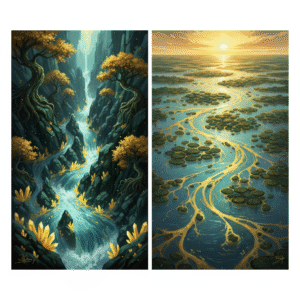
1. Defining the Flow: Joining or Splitting?
At its core, a river is a natural plumbing system, but not all streams flow the same way. The terms tributary and distributary define a stream’s relationship to the main (or parent) river channel.
Tributary: A stream or river that flows into a larger river, contributing its water to the main stem. It adds to the river’s volume.
Distributary: A stream that branches off and flows away from the main river, distributing its water into other areas. It subtracts from the main river’s volume.
Think of it this way: a Tributary Tucks In (joins), while a Distributary Divides Out (leaves).
2. Direction and Destination: The Opposite Journey
The most fundamental difference is their trajectory. This difference directly impacts the landscape and human activity around them.
Primary Action (The Core Difference)
Tributary: Gathers water and increases the volume of the main river. It’s a collector.
Distributary: Spreads water and decreases the volume of the main river. It’s a divider.
Location Along the River
Tributary: Typically found in the upper reaches of a river system, closer to the source.
Distributary: Primarily found in the lower reaches of a river, near its mouth.
Final Outlet
Tributary: Does not flow to the sea or ocean; its water joins the main river first at a point known as a confluence.
Distributary: May flow directly to the sea, a lake, or even dry up inland, often forming a delta.
River Example: The mighty Irtysh River is the world’s longest tributary, flowing into the Ob River in Russia. Conversely, the Kollidam River is a major distributary that splits from the Kaveri River in India to form a large river island.
Niger River Water Pendant: The Current of Resilience in the Land of Distributaries
3. Cultural and Historical Significance
River systems are not just geographical; they are the cradle of civilization and the highways of history.
Tributary as the Trailhead: Tributaries were often the routes of exploration. For instance, the Vermillion River—a smaller tributary of the Wabash River in North America—guided early pioneers into the interior. These smaller streams provided access but challenged boats with shallower, faster water, fostering a culture of rugged independence and local settlements.
Distributary as the Trading Hub: Deltas formed by distributaries were historically rich and complex. The Tha Chin River and the Noi River are distributaries of Thailand’s Chao Phraya River. Their branching delta channels created the fertile land that has been farmed for centuries, establishing complex water-based market economies.
4. The Ecosystem Connection: Headwaters vs. Deltas
The different locations of these features define their unique outdoor and ecological roles.
Tributaries and Clean Water: Found in the headwaters, tributaries often feature faster, colder, more oxygenated water. They are excellent for fly-fishing and are critical habitats for cold-water species like trout. Protecting small streams, like those feeding the Simsang River in Meghalaya (India), is an act of conservation that benefits the entire system.
Distributaries and Biodiversity: Found in deltas and floodplains, distributaries create vast wetlands, like those formed by the Irrawaddy River in Myanmar. These marshes support incredible biodiversity, serving as crucial nursery grounds for fish and major stopovers for migratory birds—a true outdoor enthusiast’s paradise for wildlife photography.
5. Man vs. Nature: Engineering the Flow
In some cases, the dynamic between the two systems is so volatile it requires massive engineering efforts to manage.
The Atchafalaya River in Louisiana is a famous distributary of the Mississippi River. Due to its steeper, shorter route to the Gulf of Mexico, it naturally threatens to capture the entire Mississippi’s flow, potentially abandoning major ports like New Orleans. To prevent this, massive control structures regulate the flow, highlighting the immense effort required to maintain geographical stability.
A lesser-known example is the Tärendö River in northern Sweden, a natural inland distributary that leaves the Torne River and flows into the Kalix River, far from the sea—a remarkable instance of river bifurcation deep within the landscape.
6. Where the Distributaries Go: Inland Deltas
Not every river makes it to the ocean. Sometimes, distributaries form an inland delta where the river simply splits and dissipates. These are known as endorheic deltas because they drain into an internal basin, not the sea.
The most famous example is the Okavango River in Botswana. It does not flow into any sea. Instead, its waters spread out into a massive, lush inland delta, creating a seasonal wetland that sustains one of Africa’s most concentrated and famous wildlife areas—an utterly unique outdoor spectacle that attracts travelers from all over the world.
Another prime example is the Inner Niger Delta in Mali, which is the largest inland delta in West Africa. Here, the Niger River and its major distributary, the Bani River, spread out during the wet season, creating a vast floodplain vital for local fisheries and the agriculture of over a million people around cities like Timbuktu and Mopti.
The Peace-Athabasca Delta in Alberta, Canada, is one of the world’s largest freshwater deltas. It is formed by the Peace and Athabasca Rivers where their distributaries enter Lake Athabasca. This extensive network of channels, lakes, and marshes is a globally significant wetland supporting bison, migratory birds, and the unique ecology of Wood Buffalo National Park.
7. Navigational Differences: Swift Current vs. Silt Deposits
The differing roles of these features directly determine how humans interact with them for transport and commerce.
Tributaries and Power: Because they generally flow down a steeper gradient into the main river, tributaries often have swifter currents and are usually smaller. This makes them less suitable for large commercial shipping but ideal for hydropower generation and rugged recreational uses like kayaking.
Distributaries and Commerce: Distributary channels, like the Day River leaving the Red River (Hong River) in Vietnam, typically have slower currents due to the flatter terrain near the coast. However, they frequently deposit silt and sediment, making them prone to shallowing and requiring constant dredging for large-ship navigation but remaining perfect for local fishing and smaller watercraft.
Keep them clean!
Whether it’s a cold, rushing tributary high up in the mountains or the slow, meandering distributary of the Day River leaving the Hong River in Vietnam, these water systems are the Earth’s arteries. They provide drinking water, enrich farmland, support livelihoods, and host a stunning array of wildlife.
Every action taken upstream—from avoiding toxic runoff to supporting local river clean-up efforts—affects the delicate ecosystems downstream, particularly the fragile deltas. Protecting the smallest first-order tributary is an act of conservation that benefits the entire river, the vast delta, and the coastal ocean where it finally ends its journey.
Healthy rivers mean a healthy planet. Let’s work together to keep the flow clean.
F.A.Q.
The most fundamental difference is their trajectory. A tributary flows into the main river to collect water, while a distributary branches off the main river to spread water.
A tributary is a collector; it increases the volume of the main river.
A distributary is a divider; it decreases the volume of the main river.
Tributaries are typically found in the upper reaches of a river system, closer to the source (headwaters).
Distributaries are primarily found in the lower reaches of a river, near its mouth.