The Once-in-300-Years Rainfall
The sheer scale of the 2025 flood event defied modern expectations and signaled a new normal for extreme weather events in Southeast Asia. In the commercial powerhouse of Hat Yai, the city recorded a three-day accumulated rainfall that reached an astounding 630 millimeters (nearly 25 inches). More alarming still, a single 24-hour period saw the rainfall total 335 mm—a figure that local officials and historical records cited as the highest rainfall in a single day in over 300 years of recorded history. This massive, unexpected volume of water quickly exceeded the design capacity of all city defenses. The disaster caused at least 110 confirmed fatalities in Songkhla province alone, highlighting that the rising frequency and intensity of extreme weather, driven by global climate patterns like the periodic cooling known as La Niña (pronounced: Lah NEEN-yah), makes past infrastructure standards inadequate and obsolete for future resilience.
Hat Yai’s Predicament: A Natural Flood Trap
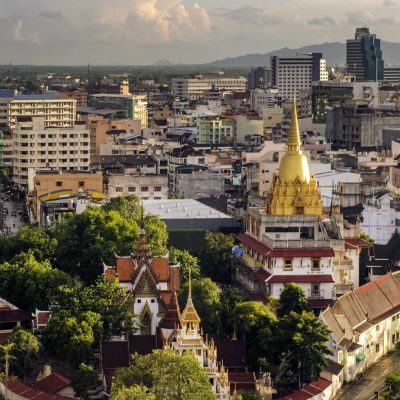
Hat Yai’s chronic vulnerability is rooted deeply in its geography and the natural function of its water systems. The city is not just near a river; it sits squarely on a low-lying floodplain within the Khlong U-Taphao river basin, which naturally acts as a massive collection basin for rainwater flowing toward the sea and the shallow Songkhla Lake. The 2025 catastrophe was worsened by a synchronized and sustained rush of water flowing in from three primary directions: the Khlong U-Taphao itself, and its major tributaries, Khlong Tam River and Khlong Waat River. This rapid, overwhelming surge meant that even well-designed flood systems had virtually no buffer capacity against the concentrated volume and speed of the runoff. The location of the city proves that no degree of construction can fully change the fundamental hydrological reality of where a river naturally wants to spread its excess water.
The Failure of Hard Engineering
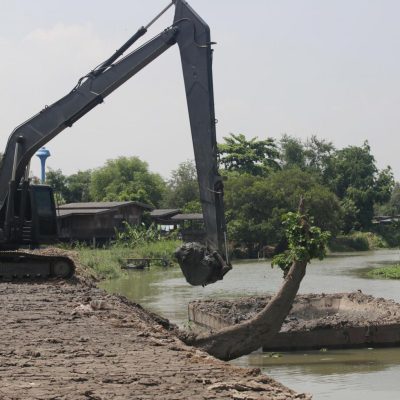
Following the widespread destruction of the 2010 flood, the government invested heavily in large-scale hard engineering solutions meant to protect Hat Yai, most notably the Khlong Phuminat Damri (Khlong R.1) diversion channel. This project was designed to route floodwaters around the main city center and into Songkhla Lake. While the Royal Irrigation Department asserts that the canal still managed to mitigate the overall scale of the devastation, the entire system was ultimately overwhelmed. Crucially, local reports indicate that the effectiveness of this key infrastructure had been compromised by a decade of factors such as the neglect of dredging (pronounced: dred-jing) and the allowance of unregulated construction along the waterway’s banks. These failures drastically reduced the channel’s effective flow capacity, proving that even vital, multi-million-dollar flood defenses are only as effective as the policy, maintenance, and oversight supporting them.
Concrete and the Loss of Resilience
The core issue facing Hat Yai is one faced by nearly every rapidly expanding city worldwide: urban sprawl and the replacement of nature with concrete. Decades of poorly regulated growth led to the paving over of the natural retention areas—low-lying wetlands, fields, and forests—that once naturally absorbed water runoff. This dense, impermeable concrete envelope drastically reduces the land’s permeability (pronounced: per-mee-a-bil-i-tee), creating massive amounts of surface runoff that move at incredible speed. The rainwater that historically took days to enter the river system via absorption and slower routes now arrives in hours, magnifying the flood peak and trapping thousands of residents in the path of deadly flash floods, demonstrating a fundamental loss of the natural resilience the region once possessed.
The Devastating Economic and Social Toll
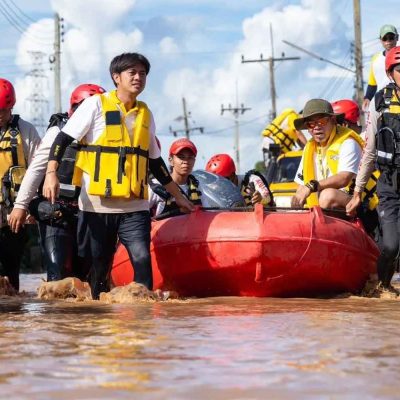
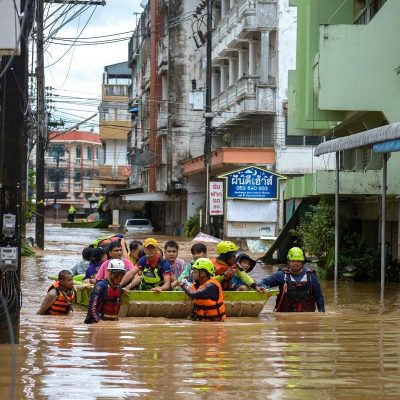
The human and financial toll of the disaster has been immense, far surpassing previous events in both scope and depth. Economically, the disaster has been a staggering blow to Southern Thailand, with losses in Songkhla province alone estimated at over 12 billion baht (approximately $372 million USD), completely paralyzing commerce in the city for days. The crisis also revealed the weakness of the modern economy: critical just-in-time supply chains collapsed instantly when major roads and bridges flooded. On the ground, relief efforts were massive and coordinated: organizations like the Prince of Songkla University (PSU) immediately set up the main evacuation shelter and medical hub, while the Royal Thai Army deployed quick-thinking soldiers using helicopters and high-clearance vehicles that were essential in the immediate rescue of thousands of stranded locals and tourists.
New Solutions for a Volatile Climate
The severe lessons learned from Hat Yai are currently driving a global conversation around new infrastructure paradigms and urban design. Future urban planning must move away from simply building higher concrete walls and instead embrace integrated, adaptive “Sponge City” concepts. This involves integrating Nature-Based Solutions (NBS), such as restoring urban wetlands, creating floodable parks, and using permeable pavement to deliberately slow and absorb water, mimicking natural absorption. This holistic approach, which is being called for by figures like Ratchaporn Poonsawat, Vice-Chairman of the Tourism Council of Thailand, seeks to coexist with, rather than conquer, the power of major water bodies like the Bang Nara River and the Saiburi River farther south.
Escaping the Urban Trap: A Regional Blueprint
The record-breaking rainfall over the Khlong U-Taphao is a local tragedy, but it is not an isolated one. As we explored in our continent-wide look at [Asia Floods: Connecting the Why Behind the Crisis and the Rivers], cities from Thailand to Vietnam are falling into the same “urban trap.” The convergence of climate-charged monsoons and the paving over of natural floodplains has created a synchronized crisis across Asia’s most vital river basins.
Breaking this cycle requires moving beyond the “hard engineering” failures seen with the Khlong Phuminat Damri. The shift toward nature-based resilience and climate-aware urban design is the foundation of our central pillar, [The Ultimate Guide to Human-Driven Flooding: How Engineering and Urban Planning Shape Our Rivers]. In that strategic guide, we dive deeper into the global “Sponge City” movement and the integrated planning necessary to ensure that rivers like the Chao Phraya and the Khlong Waat remain the lifelines they were meant to be, rather than the engines of urban disaster.
Keep them clean!
The devastating fate of Hat Yai reminds us that a river is not merely a drain for a city’s excess water; it is a vital, living artery that requires respect and continuous stewardship. Whether it is the vast, magnificent Chao Phraya River in the north, the crucial Khlong U-Taphao in the south, or the myriad smaller tributaries across Thailand, their capacity to protect us during extreme weather depends entirely on their health and free flow. Neglecting to dredge canals, allowing development to choke natural floodplains, and failing to regulate pollution are all forms of disrespect that severely weaken the river’s inherent resilience. For river conservationists and citizens everywhere, the conservationist lesson is clear and urgent: keep our waterways clean, maintain their natural capacity, and treat them as partners, not just problems to be controlled.
F.A.Q.
The most severe part of the flood event, characterized by record rainfall, occurred around November 19–21, 2025, during the late monsoon season.
The city of Hat Yai received a staggering 630 millimeters (nearly 25 inches) of accumulated rainfall over three days. A single day saw 335 mm, which was cited by officials as the highest 24-hour rainfall in 300 years.
The disaster caused at least 110 confirmed fatalities in Songkhla province alone, with Hat Yai being the epicenter of the destruction.
Initial economic losses in the province, where Hat Yai is located, were estimated at over 12 billion baht (approximately $372 million USD), severely paralyzing local commerce.
The flood was worsened by a synchronized rush of water from the Khlong U-Taphao river itself and its major tributaries, Khlong Tam and Khlong Waat, all surging simultaneously into the low-lying city.