logo-b81fc6af2faedb728fbd5fa5eeed23730c5b8be653318097907f3f0a5adbc5a6
Click for a Unique Window into the Untouched Amazon Waterway: Watch Live Now! (Courtesy of Junglekeepers)

Perennial vs. Intermittent vs. Ephemeral: Differentiating the 3 Types of Streams

Stand by a riverbed and ask: Is this water source eternal, or is it merely resting? The flow—or lack thereof—tells a deep story. It reveals a hydrological signature that dictates landscape ecology, water resource management, and regional history. Whether you are observing a powerful, ever-present channel or a mysterious dry wash, the system is at work. We will differentiate the three fundamental types of streams using the memorable P.I.E. acronym and uncover the secrets hidden in their flow.
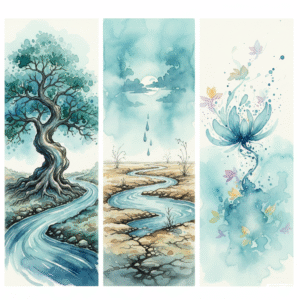
Love this cover artwork? Check out the 5 alternatives above the comment section below.

Table of Contents

The Quick Analogy: Spelling Out P.I.E.

To quickly differentiate the three types of streams and make the distinction memorable, think of the acronym P.I.E. and the predictability of when you get to eat a slice. The pronunciations are: Perennial (Puh-RENN-ee-uhl), Intermittent (In-tur-MIT-ent), and Ephemeral (Ee-FEM-ur-uhl).

  • P is for Perennial (Your Daily Meal)

    • The Pie Slice: You get this pie slice every day, guaranteed.

    • Hydrology: This represents constant, year-round flow, supplied by stable groundwater (like a reliable daily budget or salary).

  • I is for Intermittent (The Holiday Meal)

    • The Pie Slice: You get this pie slice only at predictable seasonal events (e.g., Thanksgiving or Christmas).

    • Hydrology: This represents flow that is dependable but seasonal, tied to the water table being high (like a seasonal contract).

  • E is for Ephemeral (The Surprise Dessert)

    • The Pie Slice: You get this slice only when someone unexpectedly bakes one and shares it.

    • Hydrology: This represents episodic flow, appearing quickly and intensely, tied only to a direct, singular event (a rainstorm), with no long-term stability (like lottery winnings).

Sepik River Papua New Guinea
The Sepik River Meandering Through the Tropical Lowlands of Papua New Guinea

P: Perennial Streams—The Constant Lifeline (The Daily Salary)

A Perennial Stream is the hydrological ideal—the stream that flows continuously year-round. Its defining feature is a reliable, sustained connection to the subsurface water supply.

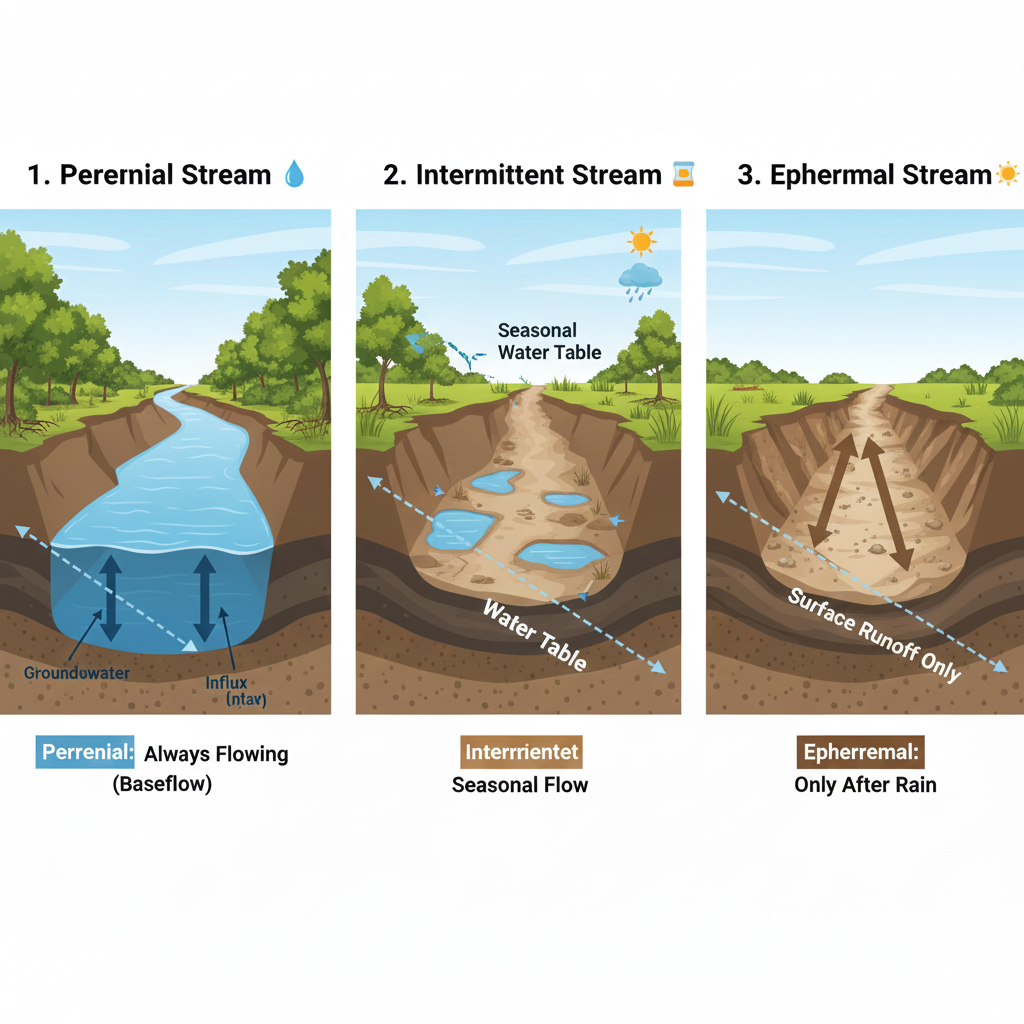
  • Primary Water Source: Groundwater (Baseflow). The streambed lies below the water table, causing water to constantly seep into the channel and sustain the flow.

  • Flow Frequency: Continuous. Flow is steady, only reducing significantly during severe drought conditions.

  • Geographical Examples: Perennial rivers are often located in high rainfall or mountainous areas. Examples include the Sepik River (Papua New Guinea), the Stikine River (Pacific Northwest), the Negro River (Amazon tributary), and the Vaal River (South Africa).

  • Ecosystem Note: The consistent flow creates deep, permanent pools and lush, year-round riparian zones, forming stable, complex ecosystems often celebrated for their scenes of permanence and vitality.

I: Intermittent Streams—The Seasonal Traveler (The Contract Job)

Intermittent Streams flow for only part of the year, typically during the wet season. They represent a temporary hydrological connection, linking the surface and subsurface seasonally.

  • Primary Water Source: Seasonal Groundwater & Runoff. They flow when the water table is high (usually winter/spring) but dry up when the water table drops below the stream bed.

  • Flow Frequency: Seasonal. They have predictable periods of flow and periods of dryness, lasting weeks or months.

  • Geographical Examples: Intermittent systems are common in areas like the U.S. Great Plains and Mediterranean climates. Noteworthy examples include the Brazos River (Texas, known for low summer flow), the Darling River (Australia, often segmented), and the Río Vinalopó (Spain).

  • Ecological Adaptation: Intermittent streams require specialized regional water management strategies and often dictate ecological rhythms. They support plant and animal species adapted to surviving long, dry periods.

Darling River River Mixer
The Darling River Channel During a Period of Low Intermittent Flow

E: Ephemeral Streams—The Phantom Wash (The Lottery Win)

The most fleeting of the three, an Ephemeral Stream flows only in direct response to precipitation (rainfall or snowmelt). This is surface hydrology in its purest form, an immediate answer to a storm event.

  • Primary Water Source: Exclusively Surface Runoff. The streambed is always above the water table and receives no sustained groundwater contribution.

  • Flow Frequency: Episodic. Flow lasts for only hours or days after a major rain event, followed by long periods of complete dryness.

  • Geographical Examples: In arid and desert regions, these flows define the landscape. The Finke River (Australia), considered one of the oldest river systems, and the Kuiseb River (Namibia), which cuts through the Namib Desert, are dramatic examples. Many channels feeding the Great Salt Lake basin are ephemeral.

  • Geological Note: The channels are striking geological features, often termed “arroyos” or “wadis” (e.g., Wadi Hadramawt River in Yemen). Their steep, carved banks and exposed sediment layers reveal the immense, raw power of episodic water flow over time.

helicopter-ride-view-over-finke-river-river mixer
Aerial View of the Ephemeral Finke River Cutting Through the Arid Landscape

Differentiating Flow: Key Field Indicators

When classifying a waterway in the field, observing the physical and biological characteristics is essential:

  • Bank and Channel Features: Perennial streams develop deep, stable banks with established, continuous root systems. Ephemeral channels, due to sporadic flow, often have shallower, less stable beds.

  • Streambed Life: The presence of fish, amphibians, or water-dependent macroinvertebrates strongly indicates a perennial or reliably intermittent flow. A dry streambed with only terrestrial insects points toward an ephemeral flow.

  • The Soil Test: If the soil in the streambed is always saturated or muddy, it suggests a strong connection to the water table (perennial). If the substrate is bone-dry and loose, it is likely ephemeral.

  • Mapping: The U.S. Geological Survey (USGS) often represents perennial streams with solid blue lines on topographic maps and intermittent streams with dashed blue lines, while ephemeral channels are usually unmapped or inferred from contour lines.

Stream Classification Based on Water Table Connection Perennial, Intermittent, and Ephemeral Flow
Stream Classification Based on Water Table Connection: Perennial, Intermittent, and Ephemeral Flow

The River Continuum Concept (RCC): Connecting the P.I.E.

The River Continuum Concept (RCC) is a fundamental ecological framework used in hydrology and ecology that provides an overarching context for these stream types. It establishes that Perennial, Intermittent, and Ephemeral streams are not isolated features, but are linked positions along a river’s entire length—a single, comprehensive watershed system.

  • Contextualizes the Types: The RCC explains why these stream types exist sequentially. Small, high-altitude headwaters are frequently ephemeral or intermittent flows, which feed into and sustain the larger, lower-elevation perennial channels downstream.

  • Emphasizes Dynamic Change: It highlights that a river system is not static; its morphology (shape), environment, and ecosystem are constantly transitioning from source to mouth as it accumulates flow and sediment.

  • Supports Management Message: Understanding these transitions is key to managing entire watershed systems. This concept reinforces the idea that what happens upstream in an ephemeral wash directly impacts the water quality and habitat of the perennial river miles away, providing the foundation for responsible stewardship.

Flash Torrent Photography Capturing the Raw, Immediate Power of Water After a Rare Rain Event

Beyond Boating: Activities on Each Stream Type

While perennial rivers are obvious hubs for swimming, fishing, and boating, the less constant streams offer unique, solitary recreational opportunities tied directly to their hydrological states:

  • Perennial Streams (The Constant): The deep, stable water allows for standard activities like fly fishing (on rivers like the Stikine) or sea kayaking where tides permit.

  • Intermittent Streams (The Seasonal): The seasonal dry periods create excellent conditions for geological foraging. When the water recedes, it leaves exposed, smooth river stones and gravel beds that are ideal for collecting unique minerals, fossils, or petrified wood. Targeted wildlife photography is also highly rewarding during the shallow-flow periods, capturing animals that are forced to the remaining water pools.

  • Ephemeral Streams (The Episodic): When dry, the wide, smooth-bottomed arroyos and wadis offer perfect natural channels for solitary, fast-paced activities. These include mountain biking (especially fat-tire biking across the exposed sediment) or trail running/hiking along paths carved by geological force. After a rare rain event, the short-lived flow offers prime opportunities for flash torrent photography, capturing the raw, immediate power of water.

To understand the broader scientific forces that shape these landscapes, explore our comprehensive guide on Fluvial Geomorphology, where we break down the five stages of river evolution and landform creation.

Keep them clean!

Whether it’s a mighty Perennial river that dictates the fate of a region or a humble Ephemeral wash that only sees water twice a year, all streams are connected. They are the veins and arteries of our planet’s water system. We must recognize that pollution or destruction in a small, short-lived stream ultimately impacts the great perennial rivers downstream, affecting water quality, ecosystems, and the very landscapes that surround us. Responsible stewardship of all waterways, regardless of their flow frequency, is essential for a healthy planet.

F.A.Q.

It stands for the three stream types: Perennial, Intermittent, and Ephemeral.

Groundwater, also known as Baseflow, which provides continuous, year-round flow.

The Ephemeral stream, which relies exclusively on Surface Runoff.

Seasonally. It flows predictably for part of the year when the water table is high, then dries up.

An ecological framework that explains how all stream types are linked, showing the continuous change from small headwaters to large rivers.

Additional resources

Zambezi River Water Pendant Necklace: The Power of Flow
Sourced from the majestic Zambezi River, this pendant is a tangible connection to the river that perfectly embodies the post's themes of flow variability and ecological rhythm. The Zambezi shifts dramatically from being a broad, slow-moving river in its upper reaches (like a Perennial stream) to a seasonally raging torrent that drops over Victoria Falls—an event dictated by the region's intense wet and dry seasons, mirroring the Intermittent hydrological cycles that sustain life. Wear this pendant as a daily reminder of the transformative power of water, the resilience of ecosystems adapted to seasonal change, and the necessity of protecting the magnificent flow that creates one of the world's natural wonders.
On Sale
Related Content
Don't miss a drop.
Sign up for new river alerts! We're continually expanding our collection with amazing waterways from around the globe. If you're searching for a specific river to enhance your craft, spiritual or research practices, subscribe to stay informed.
subscribe
Editor's note

This blog post uses publicly available information from various sources, synthesized with the help of AI, as a starting point for exploring the world of rivers. Our editors review the content for accuracy, though we encourage readers to verify information intended for primary source use. We strive to use public domain, licensed, or AI-generated images; due to the nature of online sharing, individual image sources are generally not credited. Please contact us regarding any copyright concerns.

Featured Friends
Water Footprint Network.
The Water Footprint Network (WFN) is a global, multi-stakeholder organization founded in 2008 that aims to advance the concept of the Water Footprint as a powerful tool for sustainability. The network provides crucial standards, methodologies, and data—including the foundational Water Footprint Assessment Manual—to help businesses, governments, and NGOs quantify, locate, and reduce their consumption of freshwater resources, both directly and indirectly. By using the framework of the water footprint (which measures the volume of fresh water used to produce a product or service, often broken down into blue, green, and grey components), the WFN helps stakeholders understand how human consumption patterns impact global and local water scarcity, making it essential for managing the long-term health of the very stream systems discussed in this post.
featured
our river collection
Crossword Puzzle

Collection Map
Let's Celebrate.
Travel the world, one river at a time. Explore our map and follow us as we collect precious rivers. Become part of the story by owning your own drops of history.
map
River Clips
Collection Videos.
Trace the origins of our extraordinary river water collection. Watch captivating video clips that capture the breathtaking birthplaces of these rivers.
videos
Be a River Guardian
recent posts
News
Guayas Basin, Ecuador Flood Update: Guayas and Babahoyo River Levels Rising in Babahoyo, Jujan, and Guayaquil

Current monitoring shows water levels nearing bank-full at the Babahoyo-Daule confluence as of March 9, 2026. While the coastal lowlands are accustomed to seasonal rains, the current synchronization of high-tide resistance and record-breaking upstream discharge is creating a dangerous bottleneck that threatens to submerge key transit corridors and agricultural heartlands.

Read More »
News
Nairobi, Kenya Flood Update: Nairobi & Mathare River Levels Rising in Mathare, South C, and Kibra

Current monitoring shows water levels nearing bank-full at the Museum Hill Bridge and along the Mathare River valley as of March 7, 2026. While the heavy overnight downpour of nearly 100mm has begun to subside, the saturation of urban riparian zones has left thousands of residents in informal settlements and high-traffic corridors facing unprecedented risks from surging tributaries.

Read More »
Alternative Covers

We had multiple art options for this post’s cover, but only one could make the cut. Here are 5 runner-ups. Did we choose the right one?

Leave a Reply

Your email address will not be published. Required fields are marked *

For security, use of Google's reCAPTCHA service is required which is subject to the Google Privacy Policy and Terms of Use.